
Closed-cell and open-cell foam
Spray Foam Insulation in Brooklyn, NY
Dense closed-cell where moisture, flat roofs and cold masonry meet; lighter open-cell where air sealing and quiet matter more.
- Free on-site estimates anywhere in Brooklyn
- Written quote naming foam type, thickness and R-value for each area
- Leaks, damp masonry and old wiring flagged before anything is covered
One Material, Two Very Different Foams
Spray foam insulation goes on as a liquid, expands into gaps and cracks, and cures in place, so it insulates and stops air in a single layer. In Brooklyn buildings full of odd cavities, old framing and shared walls, that air seal often matters as much as the R-value. We install two kinds of foam, and picking the right one for each surface is the first decision on every job.
Closed cell vs open cell
Cured closed-cell foam is hard and dense. HomeGuide rates it at R-5 to R-7 per inch. At normal thickness it slows water vapor, does not soak up water, and stiffens the surface it is sprayed on. Open-cell foam is lighter and softer, expands much more, and rates R-3.5 to R-3.7 per inch. It seals air well and dampens sound, but vapor passes through it, so it needs a moisture plan in a cold-winter climate.
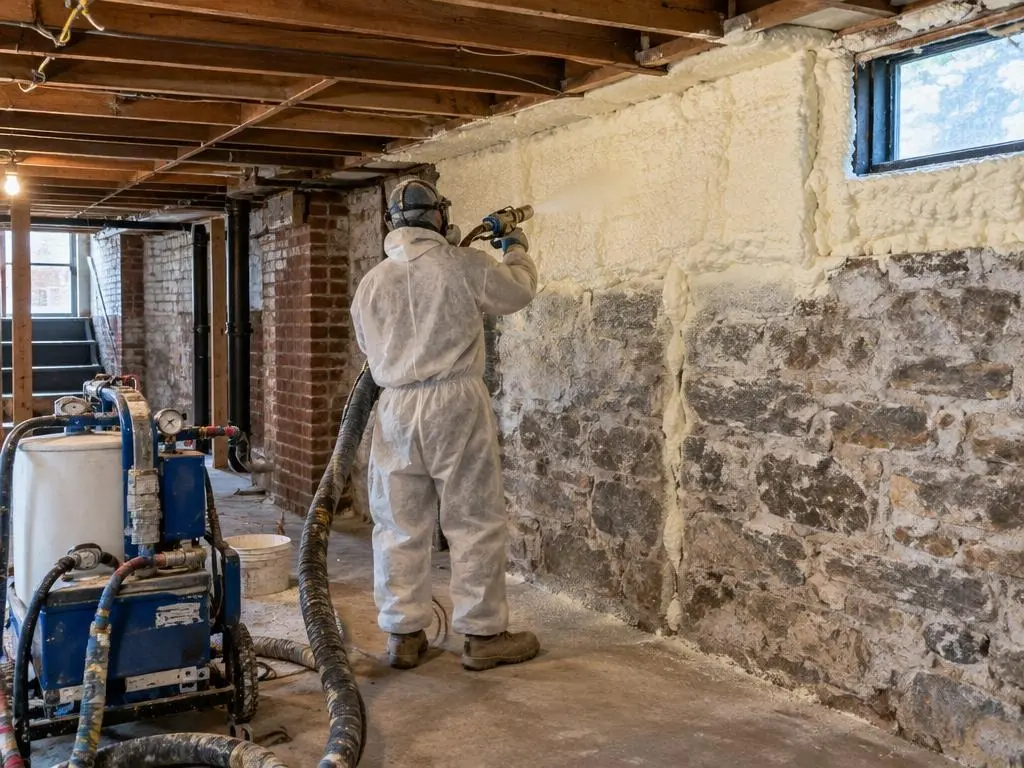
In practice, closed-cell goes where it is damp, tight or both: the underside of flat roof decks, cellar walls, rim joists, and houses near Jamaica Bay or Sheepshead Bay where flooding is a real risk. Open-cell goes in interior walls, floors between units in two- and three-family houses, and roof assemblies where the vapor control is handled another way.
Why Zone 4A pushes toward foam
The 2025 NYC Energy Conservation Code puts all of New York City in Climate Zone 4A. Its prescriptive table asks for R-49 at the ceiling and, for a wood-frame wall, R-30 in the cavity or R-20 plus R-5 of continuous insulation. Under a flat rowhouse roof with only a shallow cockloft, reaching those numbers with fiberglass while keeping room for air is hard. Closed-cell foam gets more R-value per inch and stops air at the same time. In an open 2x4 wall during a gut renovation, closed-cell can fit more insulation into a thin cavity. We size the thickness to the target and write both on the quote.
Where we spray in a Brooklyn building
The most common places are the underside of the roof deck in rowhouses, the rim joist where the wood floor framing sits on the foundation, and exterior walls left open during a renovation. In frame houses we also seal the floors of rooms that hang over porches or garages, kneewalls in houses with half-story attics, and the gaps around chimneys and plumbing chases that run the full height of the house. In mixed-use buildings we often foam the ceiling between a store and the apartments above to cut noise and drafts.
Foam and old masonry
Brownstone and old brick absorb rain and need to dry, either to the outside or to the inside. Foam sprayed tight against the inside of a solid masonry wall changes how that wall dries, and in some walls that can mean wet brick in winter and more freeze-thaw wear. Where a masonry wall gets regular rain and has no cavity, we talk through the risk and the alternatives before recommending foam. Party walls between heated houses usually need no insulation at all.
Getting ready and getting back in
We cover floors and belongings, mask windows and fixtures, and set up ventilation. HomeGuide advises staying out of the house for 24 hours or more while foam cures. Foam in living space generally has to be covered by a thermal barrier such as drywall, which we plan for on the quote. Once cured, foam does not settle, so the thickness we install is the thickness you keep.
Tell us which spaces you have in mind and what you have noticed: a hot top floor, drafts, cold floors or noise between units. We will look, explain where foam earns its cost, and send a written price. Get a free estimate
Where Spray Foam Goes
The areas we spray most often in Brooklyn, and the foam we usually choose for each.
Closed-cell spray foam
Dense foam at R-5 to R-7 per inch (HomeGuide) that slows vapor; used on roof decks, cellar walls, rim joists and in flood-prone houses.
Open-cell spray foam
Lighter foam at R-3.5 to R-3.7 per inch that seals air and absorbs sound; used in interior walls and between floors.
Flat roof decks and cocklofts
Foam on the underside of the roof deck where there is no room for loose fill and a vent channel.
Rim joists
The band of framing on top of the foundation, sealed and insulated in one pass.
Open walls during renovation
Exterior stud walls in frame houses and furred-out walls in rowhouses, sized to the Zone 4A wall target.
Floors between units
Open-cell foam in floor framing to cut drafts and noise in two- and three-family houses.
Published Spray Foam Insulation Costs
| Job | Range and source |
|---|---|
| Spray foam, installed | $1.50 to $5.00 per sq ft (HomeGuide) |
| Open-cell / closed-cell | $1.50 to $3.50 / $3.00 to $5.00 per sq ft (HomeGuide) |
| About 1,000 sq ft | $1,500 to $5,000 (HomeGuide); $3,150 to $7,500 existing home (Fixr) |
| Existing walls / new construction | $3.15 to $7.50 / $2.75 to $6.50 per sq ft (Fixr) |
| All exterior walls | $4,000 to $10,000 (HomeGuide) |
| Whole house | $8,000 to $20,000 (HomeGuide); $10,000 to $30,000 (Fixr) |
| Typical job minimum | $1,000 to $2,000+ (HomeGuide) |
National figures from HomeGuide's 2026 guide and Fixr's 2025 guide. Foam type, thickness, access (stoops, roof hatches, tight cellars) and prep move the total. You pay the amount written on our estimate, not a range.
How a Spray Foam Job Runs
1. Site visit
We inspect each space, look for roof leaks, damp masonry, old wiring and suspect materials, and measure.
2. Written quote
Each area lists foam type, thickness, target R-value, thermal barrier plan and price.
3. Prep
We protect floors and belongings, mask what needs masking and set up ventilation.
4. Spray and trim
Foam goes on in passes to the planned thickness and is trimmed where needed.
5. Cleanup and walk-through
We clean up, show you the work and tell you when the space is ready to use.

Why Choose Us for Spray Foam Insulation
Foam only where it pays
If blown-in or simple air sealing does the job for less, we say so.
Masonry handled with care
We explain how foam affects old brick and brownstone before it goes anywhere near them.
Spray Foam Insulation Questions
Is closed-cell foam worth the extra cost?
For flat roof decks, cellar walls, rim joists and flood-prone houses, usually yes: it slows vapor and gets more R-value per inch. In interior walls and between floors, open-cell often does the job for less. We price both where both would work.
How long do we need to stay out after spraying?
HomeGuide's advice is 24 hours or more while the foam cures. For work limited to a cellar or a cockloft, the plan may be shorter or simpler. We confirm timing for your job before we start.
Does spray foam need to be covered?
Foam plastic in occupied space generally has to be covered by a thermal barrier such as half-inch drywall. In a cockloft or crawl space the rules can differ. The quote states what covering we plan.
Will spray foam stop a roof leak?
No. Foam can hide a leak, and water trapped behind it can rot the roof deck. Roof leaks get fixed first, and then we insulate.
Can spray foam reduce noise from the street or the apartment above?
Open-cell foam absorbs sound and seals the gaps that let noise through, so it helps between floors and in interior walls. Windows are usually the main source of street noise, so foam alone will not silence a busy avenue.
Spray Foam Insulation Service Areas
- Spray Foam Insulation in Brooklyn, NY
- Spray Foam Insulation in Park Slope, NY
- Spray Foam Insulation in Brooklyn Heights, NY
- Spray Foam Insulation in Williamsburg, NY
- Spray Foam Insulation in Greenpoint, NY
- Spray Foam Insulation in Bushwick, NY
- Spray Foam Insulation in Bedford–Stuyvesant, NY
- Spray Foam Insulation in Crown Heights, NY
- Spray Foam Insulation in Flatbush, NY
- Spray Foam Insulation in Ditmas Park, NY
- Spray Foam Insulation in Midwood, NY
- Spray Foam Insulation in Sunset Park, NY
- Spray Foam Insulation in Bay Ridge, NY
- Spray Foam Insulation in Dyker Heights, NY
- Spray Foam Insulation in Bensonhurst, NY
- Spray Foam Insulation in Sheepshead Bay, NY
- Spray Foam Insulation in Gerritsen Beach, NY
- Spray Foam Insulation in Canarsie, NY
- Spray Foam Insulation in Red Hook, NY
Get a Spray Foam Insulation Estimate
Tell us the spaces and what you have noticed. We will look and send a written foam plan and price.