
Waterfront rowhouses and warehouses
Spray Foam Insulation in Red Hook, NY
Old dockworker housing and industrial buildings on low ground.
- Free on-site estimates anywhere in Brooklyn
- Written quote naming foam type, thickness and R-value for each area
- Leaks, damp masonry and old wiring flagged before anything is covered
Old Waterfront, New Uses
Spray foam insulation in Red Hook deals with old waterfront buildings. Wikipedia describes how dockworkers lived in boarding houses, some of them speculatively built rowhouses, and notes that Red Hook was heavily damaged by Hurricane Sandy in 2012. The Red Hook Houses, completed in 1939, are the largest public housing development in Brooklyn, home to about 6,000 people.
Flood-aware work
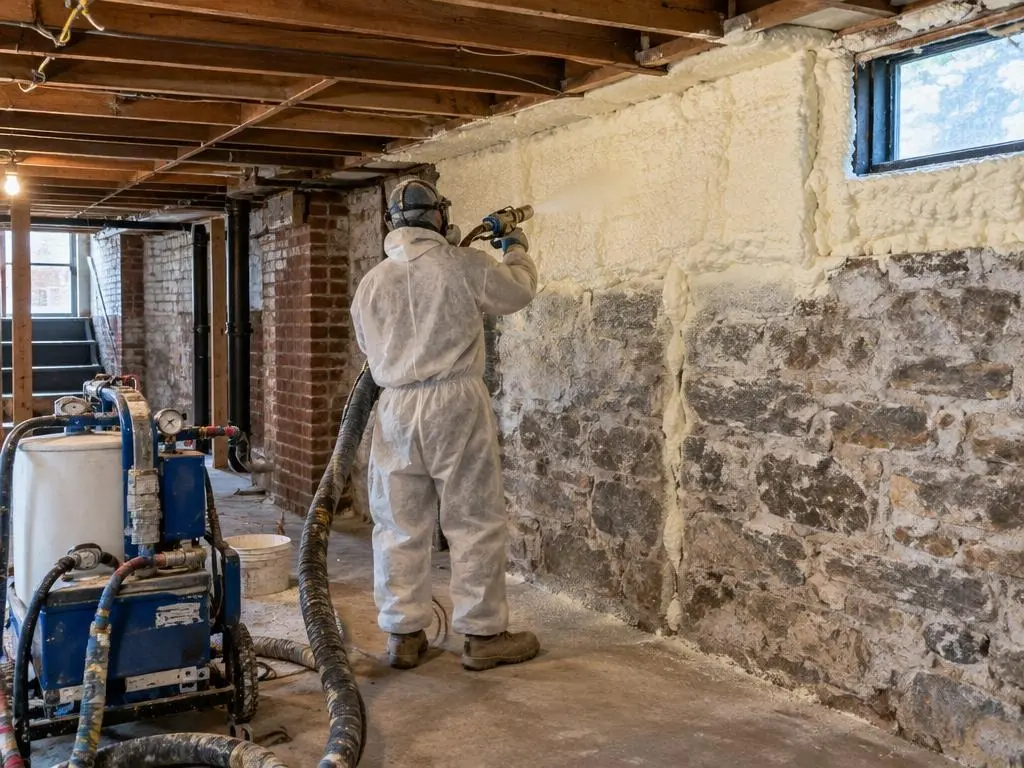
Red Hook sits low on the harbor. In cellars and ground floors that could flood, we use closed-cell foam, which absorbs very little water, and avoid batts that would have to be torn out. Above that level, normal options apply.
Rowhouses and conversions
The rowhouses are classic Brooklyn: flat roofs over cocklofts, masonry walls and rim joists at the cellar. Converted industrial buildings have exposed roof decks, high ceilings and masonry walls; closed-cell foam under the deck with a thermal barrier is a common fix.
Code target
The 2025 NYC Energy Conservation Code puts Red Hook in Climate Zone 4A, listing R-49 at the ceiling and R-15 or R-20 continuous for mass walls. Renovations of old masonry buildings often aim at those numbers.
Wind off the harbor
Red Hook sits on a peninsula with Upper New York Bay on its west and south sides and the Gowanus Canal to the east, so wind off the water presses against every wall. That makes air sealing as important as R-value: gaps at window frames, the rim joist, the cockloft hatch and around pipes let cold harbor air straight in. We seal those paths before adding insulation, and in the rowhouses we pay special attention to the rear walls and top floors that catch the wind.
Mixed-use and commercial spaces
Many Red Hook buildings combine a shop, studio or workshop on the ground floor with living space above. Sealing and insulating the floor between them keeps heat, noise and odors where they belong. In warehouse and studio spaces that are used year-round, foam on the roof deck and on the inside of exterior masonry walls, where the masonry can handle it, makes the space much easier to heat.
Get a visit and a written price for each area. Get a free estimate
Red Hook Facts
- Sandy. Red Hook was heavily damaged by Hurricane Sandy in 2012 (Wikipedia).
- Dockworker housing. Many Red Hook dockworkers lived in boarding houses, some of them speculatively built rowhouses (Wikipedia).
- Red Hook Houses. The Red Hook Houses, completed in 1939, are Brooklyn's largest public housing development, housing about 6,000 people (Wikipedia).
Red Hook Questions
What insulation should go in a ground floor that could flood?
Closed-cell foam. It absorbs very little water and often stays usable after a minor flood.
Can you insulate an exposed warehouse roof deck?
Yes, with closed-cell foam on the underside and a thermal barrier where the space is occupied.
Do you work in mixed-use buildings?
Yes. We insulate the apartments, the roof and the floor between a commercial space and the units above.
Spray Foam Insulation Near Red Hook
- Spray Foam Insulation in Brooklyn, NY
- Spray Foam Insulation in Park Slope, NY
- Spray Foam Insulation in Brooklyn Heights, NY
- Spray Foam Insulation in Williamsburg, NY
- Spray Foam Insulation in Greenpoint, NY
- Spray Foam Insulation in Bushwick, NY
- Spray Foam Insulation in Bedford–Stuyvesant, NY
- Spray Foam Insulation in Crown Heights, NY
- Spray Foam Insulation in Flatbush, NY
- Spray Foam Insulation in Ditmas Park, NY
- Spray Foam Insulation in Midwood, NY
- Spray Foam Insulation in Sunset Park, NY
- Spray Foam Insulation in Bay Ridge, NY
- Spray Foam Insulation in Dyker Heights, NY
- Spray Foam Insulation in Bensonhurst, NY
- Spray Foam Insulation in Sheepshead Bay, NY
- Spray Foam Insulation in Gerritsen Beach, NY
- Spray Foam Insulation in Canarsie, NY